By Kyle Moen
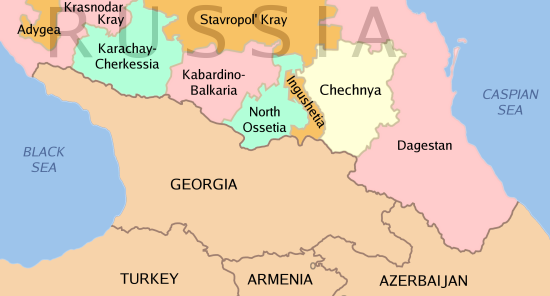
The current tensions that face the North Caucuses region have been drawn from a history of being one of the most ethnically diverse areas in the world and the struggle each ethnic group has when fighting for enough space to call their own sovereign homeland. The main actors in this struggle are the Ossetians, the Chechens, the Abkhaz, the Azeri (Azerbaijan), the Armenians, the Ingush, the Dagestani, the Georgians, and finally the Russians themselves who used to control all of these people under the iron grip of both Czarist Russia in the 19th century and the USSR of the 20th century. There are dozens of other ethnic groups, but the ones I have mentioned are the ones that make the headlines and have the most weight in the region. This report will focus on the history that Georgia has played in structuring these tensions because Georgia is at the very heart of it all.
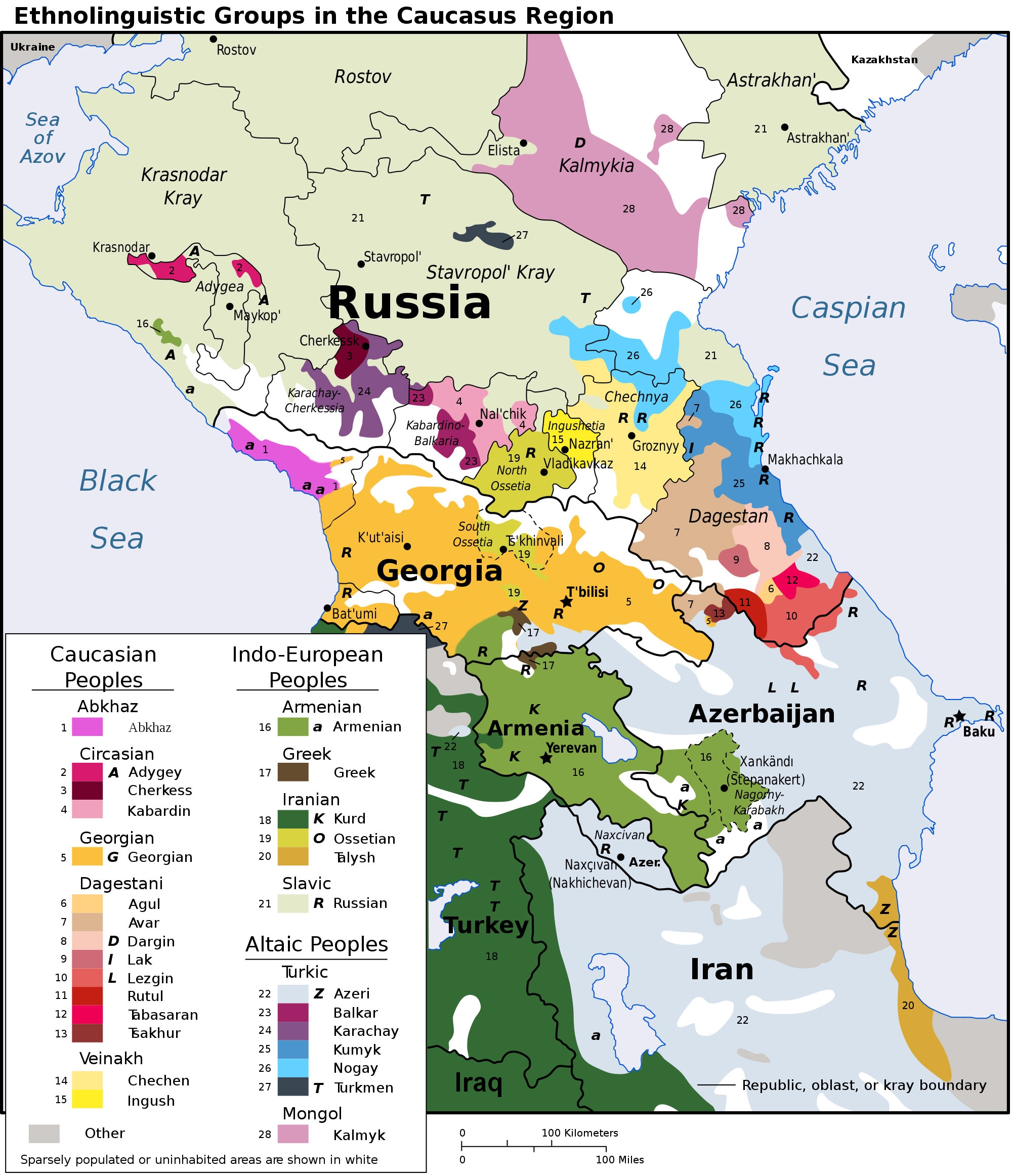 |
| Ethnic Groups in the Caucasus |
In many ways the history North Caucuses region is eerily similar to that of Afghanistan because throughout ancient and medieval times they were both the major crossroads of eastern and western civilization. It is the very cradle of all Indo-European languages. Dozens of tribes, religions, and customs bumped into each other’s paths when migrating or invading past each other. All of these groups wanted equal access to the old Silk Road which was the major trade network between Europe, India, Africa, and China. After Medieval times the Silk Road lost its significance due to Europeans establishing new trade routes over the oceans, but the area was dominated successively by the Muslim powers from the south namely the Ottoman Empire and the Safavid Persians and by Mongols from the east and many tribes were converted to Islam. The Ottomans who were Turks from the east broke apart the old Byzantine Empire and thus severed ties of the Orthodox Christians between old Constantinople and present day Georgia. By the 18th century the Muslim Mongol Empires dissolved and faded away and the new Russian Empire had grown to great strength and continually added new territories to the south and east to control the trade in the Black Sea and gain new resources.
Seeing Russia as the reincarnation of the Byzantine Empire, Georgians who were at the time an island of Christians in a sea of Muslims (Chechens, Ossetians, Azeri, Ottomans, and Persians) asked the Czarist government for help. Through successful military campaigns in the Caucasian wars from 1817-1864 neighboring Muslim groups were defeated and the land we now call Georgia was gradually transformed into a semi-autonomous republic under control of the Czarist government in Moscow. It would remain under this control even under the Bolshevik Revolution when the Czarist system was replaced by a communist one named the Soviet Union. One of the best known leaders of the Soviet Union, Joseph Stalin was himself a Georgian. Although this should have brought great freedoms to the Georgian people, it in actuality didn’t under the Soviet Union and throughout the Soviet years Georgians were constantly persecuted by their Russian peers.
During the 1980s with the weakening of the Soviet state due to its costly war in Afghanistan, Georgia became the first republic to peacefully rebel against its Russian occupiers, but the demonstration was stamped out by Russian soldiers in 1989. This should have been a sad moment in the Georgian independence movement, but happiness came just 2 years later when the entire USSR was destroyed and almost all semi-autonomous republics sought their own self-determination and became sovereign states, Georgians doing so in April of 1991 and electing Zviad Gamsakhurdia to be their first President. This man would only last a year in office because of his authoritarian methods, in early 1992 he was kicked out of the country by a military led coup.
To restore order Eduard Shevardnadze, Georgia’s former communist leader became president the country’s de-facto president in 1992 and in 1993 he crushed rebellious forces who wanted to put Gamsakhurdia back into power. He again would survive many assassination plots to be re-elected 2000. During 2003/2004 he would be replaced by a pro-western man named Mikheil Saakashvili who won after a disputed election where Shevardnadze tried to manipulate the election process which led to mass protests known today as the “Rose Revolution”. He quickly realized that Georgia was facing many internal problems dealing with semi-autonomous areas in Georgia itself, mainly with Adjaria, South Ossetia, and Abkhazia where growing pro-Islamic fundamentalism was growing. He addressed the problem of Adjaria right away, but found it very difficult in dealing with South Ossetia because the court in South Ossetia ruled in 1989 ruled to join its brothers in North Ossetia.
This was before the breakup of the USSR and North Ossetia belongs to Russia. Open warfare has occurred between the two has occurred in 1991 with upwards of 100,000 refugees being displaced. In 1992 Georgia accepted a cease fire agreement that was set up by Organization for Security and Co-operation in Europe (OSCE) and South Ossetia is recognized as an autonomous zone outside central Georgian authority. Over the 90s and into the 2000s Saakashvili has offered them autonomous rights, but the President Eduard Kokoity of South Ossetia has pushed for full sovereignty with the backing of Russia because he wants full union with his northern brothers and their culture is far too different than that of Georgia being that Ossetians have Persian roots with Islam at its core.
In November 2006 South Ossetia came to the decision to be independent during a referendum and talks with the Georgian government broke down. President Dmitry Medvedev of Russia recognized their independence and on August 8th of 2008 invaded Georgia with his army. He sees this as a just cause for rescuing the Ossetian people but his real motives is to contain Georgia and scare the rebellious Chechens who want to break away from Russia. Georgia is a roadblock in that plan. The same can be said for Abkhazia in the fact that the Russians invaded at the same time but with different results because today only Russia, Nicaragua, Venezuela, and Nauru recognize it as an independent nation. Abkhazia has since the struggles of the early 90s gotten away ethnic cleansing (rape, vandalism of shops, looting, mass murder) on Georgians forcing them move out of the area as refugees and all with full financial and military backing of the Russian government. To this day Georgians are not allowed to vote Abkhazia.
None of the leaders of Abkhazia have been brought to justice like in the case of Milosevic of Serbia in the 1990s that was captured by NATO forces for his destruction of Kosovo. Nicholas Sarkozy of France was the in charge of the cease-fire agreement which orders Russian troops to withdraw from Georgia entirely and respect their sovereign territory. Medvedev as of today celebrates the anniversary of the invasion like it was his birthday, He and Vladimir Putin still dream of a much larger Russian Empire where Georgia is just a province. Our country plays on both sides of the fence because at the same time we are fighting the War on Terror we are also apart of NATO plus the UN Security Council so we so we don’t condone the invasion of a sovereign nation. It to this day is a political nightmare for the White House in that Russia criticizes our government for the invasion of Iraq and Afghanistan.