Showing posts with label Iraq. Show all posts

Wednesday, June 25, 2014

Implications of the Iraqi Crisis

By Jordan Morris

Flag of the Islamic State of Iraq and Syria
Within the last few weeks we have watched a paradigm shift in Middle Eastern foreign relations. With The Islamic State of Iraq and al-Sham on Baghdad’s doorstep, the US is confronted yet again with the prospect of becoming involved in one of the most turbulent states of the Middle East. ISIS’s conquest in Northern Iraq and Syria has already led to President Obama doing something no one thought he would ever do: send American troops back to Iraq. The limited deployment brought some 300 military advisors to assist the Iraqi army in fighting the lingering ISIS militants who have stopped just short of Baghdad, but have explicitly stated their intent to take Iraq’s capital city. ISIS fighters, led by Abu Bakr al-Baghdadi, will find that Baghdad is not Mosul or Tikrit, and at that the Iraqi government’s last stand will not be taken alone. 

Iraq has pleaded for help from the US and received a limited response, one that is unlikely to be followed up with any significant US presence or even the air-strikes that Prime Minister Nouri al-Maliki had petitioned for. Even without major assistance from the US, Maliki’s government may still stand, thanks to Iran. On June 18th Iran’s president, Hassan Rouhani, gave a speech at the Iraq-Iran border, pledging to do whatever it took to protect Shia populations and holy sites in southern Iraq (a move reminiscent of Vladimir Putin, who invaded Crimea citing his government’s duty to protect Russian nationals in Ukraine). At the eleventh hour, when an ISIS attack on Baghdad is imminent , we may very well see an anomaly of world politics take place—cooperation between the US and Iran. Both Iran and the US have been clear that there will be no conventional military coalition between the countries, but undoubtedly both recognize a common interest in protecting the current state of Iraq. Consequently, Iranian Supreme Leader Ayatollah Ali Khamenei has condemned cooperation, and suggested that the US is using this issue to further sink its teeth into Middle-Eastern affairs. 

The ‘enemy of my enemy is my friend’ scenario is an optimistic look at the future of relations between the US and its historical adversary, but some, and specifically Israel, are wary of cooperation with the Islamic Republic. Understandably the small Jewish state is highly skeptical of and opposed to its biggest ally cooperating with a government that has time and time again threatened to destroy it, but Iranian action supported by the U.S. could actually benefit Jerusalem. ISIS has been clear its vision of al-Sham includes the lands of Palestine. The militants announced the development of a special unit, the Al Quds Unit, whose mission is to destroy the “Zionist regime occupying Palestine,” according to an article on CounterPunch.org

Tuesday, June 17, 2014

ISIS in Iraq

By Jordan Morris

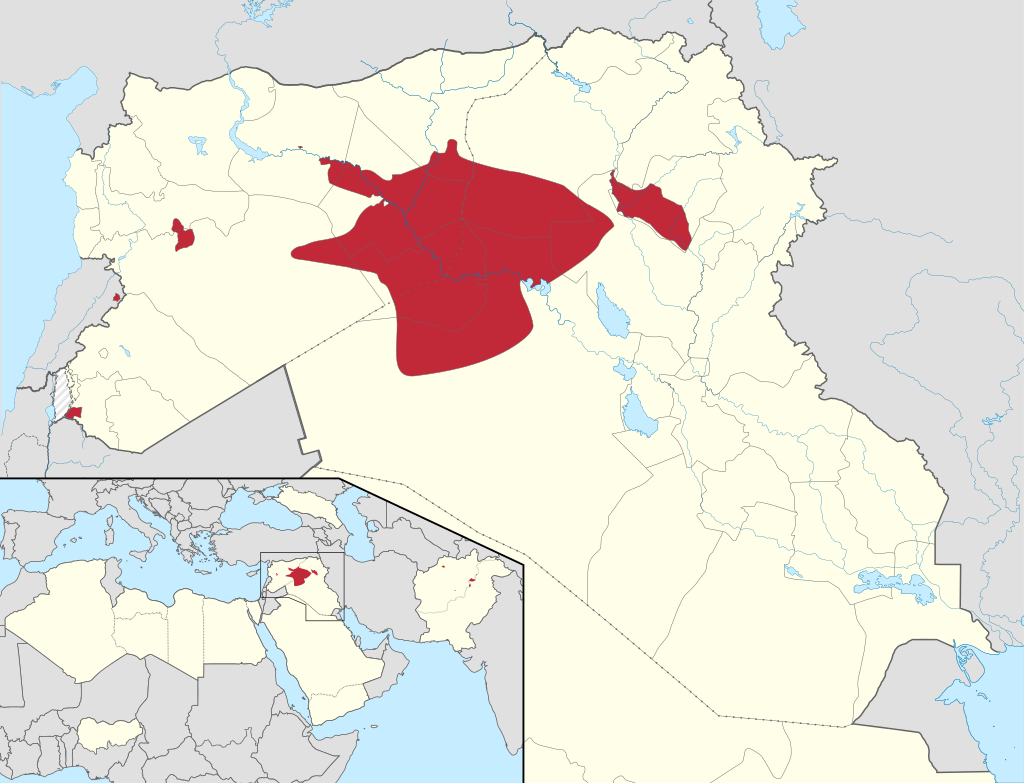
ISIS-controlled territory as of June 2014
Between June 6th and June 9th, Iraq’s second largest city was taken by the Islamic State of Iraq and the Levant, also known as the Islamic State of Iraq and al-Sham (ISIS). The adolescent Islamic group splintered from al-Qaeda in April of 2013 and has carried out attacks throughout Northern Iraq and Syria since. 

ISIS has been successful on both their Syrian and Iraqi fronts. During their siege of Mosul, ISIS defeated the US-trained and 15-times-as-large forces of the Iraqi government. Images from the battle show signs of desertion by both the Iraqi army and local police. ISIS emir, Abu Bakr al-Baghdadi, has been able to hold the largely Sunni regions north and west of Baghdad as well as establishing interim governments lead by ISIS officers. The rebel group’s forces have been numbered at under 1,000, but their swift and brutal tactics, along with support from Sunni tribal communities, have allowed them to maintain course. Currently ISIS controls Fallujah and Tikrit, as well as large swaths of northwestern Iraq and eastern Syria. Their goal is to form a caliphate stretching from the Lebanese Mediterranean to the Zagros Mountains of Iran

While the Islamic State of Iraq and al-Sham continue making political and economic gains in pursuit of their explicit goal, taking Baghdad, Kurdish forces in the north have seized their opportunity to gain control of “Kurdish Jerusalem”, the oil-rich city of Kirkuk. Kirkuk, which lies just outside of the Kurdish autonomous region, was a landmark victory for Kurdish Iraqi’s who seek to forward their own goals of a united and independent Kurdistan. The Kurds were able to regain their historic capital in the midst of turmoil and government desertion brought upon by ISIS operations in the area. Unprecedented gains by the Kurds and the inability of the Iraqi government to assert any sort of authority near Kurdish populated regions make the image of Kurdistan all the more vivid. 

Iraqi Kurdish troops, known as the Peshmerga, maintain representation within Iraqi parliament. Shoresh Haji, who represents the Kurds within the Iraqi government, praises the Peshmerga’s reclamation of Kirkuk, but maintains that the Kurds must work with the Iraqi government to fend off ISIS, and use their support as leverage for Kurdish interests in the Iraqi Parliament. According to Haji, the unrest in the north presents, “…an opportunity we cannot ignore”. 

Both the Peshmerga and ISIS seem to be benefitting from the Iraqi government’s inability to maintain stability, but for hundreds of thousands of refugees and Internally Displaced Persons (IDPs), the future remains bleak. The Syrian crisis has created an estimated 2.8 million refugees. Of that number, 200,000 found shelter in Iraq. On top of these 200,000, almost 500,000 fled Mosul after fighting broke out. The dysfunction of the Iraqi government offers little to be optimist about for those displaced by the recent surges of violence in their temporary homes. 

The splintering of Iraq, marked by the military and political ambition of ISIS and the Peshmerga alike are a testament to the futility of long-term solutions for stability. It is not only governments in the Middle-East that seem prone to this ideological splintering. ISIS themselves were shed from formal al-Qaeda ranks. This disintegration can be seen taking place within the Taliban as well. On Sunday night the TTP or Tehrik-i-Taliban Pakistan, carried out attacks at Jinnah International Airport in Karachi, leaving at least 34 dead. On Tuesday, the group was involved in more attacks at Jinnah Int’l, this time targeting the Airport Security Forces Academy. The TTP maintains ideological differences with the Afghan Taliban, and have themselves experienced mutiny within their ranks with the Meshud faction deciding that they no longer wished to be affiliated with those who employ tactics such as ransom, extortion, and mass killing

Iraq is now a splintered state, with each splinter seeking its own path. Should they realize their goals, it would mean the end of contemporary borders In the Middle-East. Factionalization, while it has crippled the very governments militants like the TTP or ISIS fight against, is a virus that infects indiscriminately and carries the same side effects. The mission of Islamic rebel groups and their interpretation of the Koran is subject to their leadership. Should the interpretations contradict each other, it can mean conflict and even war. Similarly should the ideologies of factions within militant groups fail to be cohesive, it could mean the end of an otherwise successful campaign.

Saturday, March 17, 2012

Guerrilla Warfare in Iraq: Al-Qaeda and Insurgency

By Erica Hach

Walzer dedicates an entire chapter to explaining the pros and cons of the guerrilla tactic and questioning its morality. He doesn’t necessarily come to a concrete conclusion, but makes it very clear that civilians become much more at risk during guerrilla wars than they would in traditional battle. This was displayed in Iraq on Monday, March 5, 2012, when insurgents came into the city of Haditha and killed 25 police officers. Officials say the band of rebels came riding into the city in vehicles disguised as the vehicles of city officials and captured many policemen using false arrest warrants. Several killing sprees occurred at various times and places throughout the city.

I don't know how Walzer would feel about this specific attack. It’s been stated in previous chapters that combatants are always liable to be killed while noncombatants are never liable to be killed. Although it is stated that no civilians were killed, can policemen really be considered combatants in this situation? I’m not exactly sure about that. Of course they knew the dangers of signing up for the job, and maybe even therefore lost their right to life, but the fact that the insurgents deceived everyone by creating false identities as officials creates a new side of the argument. Also, I’m not entirely sure that there is a war going on between the Iraqis and the insurgents to begin with. I mean obviously there is conflict there but has the Iraqi government declared war against Al-Qaeda? If not, then their behavior is mere terrorism, which is exactly what the United States accused them of. I feel that Walzer would insist that this attack wasn’t at all justified. Civilians of this city are now living in total fear and are completely upset over the loss of their loved ones, which is to be expected. The insurgents have accomplished very little, it seems. They have probably recruited more people to the opposition (those who are upset over the loss of innocent lives) and have angered an entire population.

Saturday, March 10, 2012

Henry Sidgwick and 'Mischief' in Iraq

By Erica Hach

Henry Sidgwick states that “During war it is impermissible to do any mischief which does not attend materially to victory, nor any mischief of which the conduciveness to the end is slight in comparison with the amount of mischief” (Walzer, Just and Unjust Wars, 129). I’m going to break this apart and apply it to the war that the United States engaged in with Iraq. 

Sidgwick’s first main point is that a state should not do anything that does not directly lead to victory in war. Whether or not the war itself was justified is completely irrelevant according to this statement. It seems that the United States has basically followed this part of the statement. However, there have been occasions in other nearby places when individuals have crossed such boundaries (such as when American soldiers peed on the dead bodies of the Taliban in Afghanistan).

It’s Sidgwick’s second point where the United States will be questioned more. The second part calls states to question whether they’re doing more good than bad. Are the bad acts that have been committed “worth it” for the victory? Many lives were lost during United States’ involvement in Iraq and now that we have pulled our troops, it’s questionable whether victory was even obtained at all.  Ned Parker of the Council of Foreign Relations explains that even though the violence has somewhat subsided since United State’s initial involvement, that there is still a legitimate fear among the Iraqi population. So was it really even worth it for the United States to get involved and for so many lives to be lost if circumstances have hardly changed?

It is also important to consider one very important aspect that Sidgwick does not include, and that is human rights. Some actions are simply never justified, regardless of how crucial they are to victory. Society and humanity has some very strict rules and limitations on what the morality of wars and warfare, which is another topic entirely. The main point here is that while Henry Sidgwick refers only to necessity and proportionality in warfare, it is also very important to consider human rights.

Tuesday, February 21, 2012

Controversy: Drones in Iraq

By Erica Hach

A month after removing all troops from Iraq, the United States could still be considered quite involved in the ongoing conflicts taking place there. The State Department has recently placed unarmed drones in the country to ensure safety within the United States Embassy and its members. Officials have claimed that the goal of the drones is “to provide real-time surveillance of fixed installations, proposed movement routes and movement operations” (The New York Times). I feel it’s very relevant to question whether this action is not only necessary, but is it even justified? As expressed in the first paragraph of The New York Times, this is very close to infringing on the Iraqi’s political sovereignty, which is considered to be one of states’ universal rights according to Walzer. The drones are also infringing on Iraq’s territorial integrity, by invading the borders, which is another of a state’s assumed rights.

I feel torn on this specific subject. On one side, the United States should keep self-interest in mind and protect it’s own citizens. Walzer makes arguments that each state should look out for their own wellbeing and ensure the safety of their own people first. However, on the other hand, we must think of the rights that the Iraqi individuals are entitled to and the boundaries that the US is potentially crossing by continuing to “keep watch” in the country. United States officials assure that these drones are essentially harmless and that they have no possibility to be armed and are not planning an attack in any sense of the word. Regardless, they are still violating the political sovereignty and territorial integrity granted to the country, which is typically considered an act of aggression.

Tuesday, February 14, 2012

Iraq Sunni Boycott of Parliament Ended

By Katie Jewison

There may be an ease finally settling into the Iraqi politics. The nearly 76 lawmaking Sunni ministers have once again returned to the cabinet on the Tuesday session. With their return thereis now a stage for a national conference to find solutions to the conflicts and suspicions of a civil war that have  erupted since the United States troops left in December. 

The boycott had first begun to protest alleged persecution of Sunni officials. The Shite-led government hadissued a warrant for arrest on the Sunni Vice President, Tariq al-Hashemi, on terrorism charges and for allegedly running death squads. The government also attempted to fire Deputy Prime minister Saleh al-Mutlaq, for calling another official “a dictator in the press”. Since the Sunni’s backed their officials,the group agreed to leave parliament, which produced a standstill in Iraq’s politics. With surges in violence and nearly 200 people killed this month,there had been a political crisis with fears of civil war arising. Since these fears had been arising the Sunni came back into parliament under the conditions of leaving Hashemi’s conflict to the courts and also having Mutlaq apologizefor the statement he had made.

Since the parliament is now all back on board the country can now take a step toward in resolving its crisis. President Talabani, a Kurd, has been in the process of setting parameters for anational conference that could happen within the coming weeks. This conference could help the three main factions--Shiites, Sunnis, and Kurds--to at start topaper through differences, which will help to prevent a collapse of government and possible, a slide into a civil war. This conference is going to be a big step for the Iraqi government and hopefully bring them one step closer to resolving there issues.

Here are some links to the newspaper articles: New York Times and The Washington Post

Friday, February 3, 2012

Iraq Death Toll Increases

By Katie Jewison

It has been reported that 434 people have been killed in Iraq since the United States has evacuated the country. This number is one of the highest causalities the country has seen in the last few years. Many of these attacks were aimed at the Shiites which is making many people wonder if the insurgent group Al Qaeda is starting to gain footing since the United States have now pulled out. This group has decreased significantly over the years of the US invasion. Al Qaeda had released a statement saying that they are focusing on targeting the Shiites in an attempt to push back Iran’s influences on Iraq. Although the average number of deaths per day is now at eleven compared to this time last year when it was nine, the Iraqi security officials are claiming that the fight against the insurgents is increasing its success. They have also claimed that it is now easier to fight off the attacks with the United States gone.

I do not understand how the security officials can possibly say that it is now easier to fight off the Al Qaeda. As you can see the number of deaths everyday has greatly increased, showing that the United States involvement was decreasing Al Qaeda's power! I believe that the United States involvement was a large part in eliminating the attacks. Also I believe that these attacks on the Shiites is only going to continue until the insurgents either get what they want or others get involved once again. They seem to be trying to undermine the Shiite-led government's confidence in protecting their people. With all the violence that has increased since the U.S. pull out I believe that Iraq is on the verge of a civil war.

Here is a link to article on the recent attacks in Iraq: New York Times.